
Chiropractic Interventions for Lumbar Disc Herniations and Sciatica
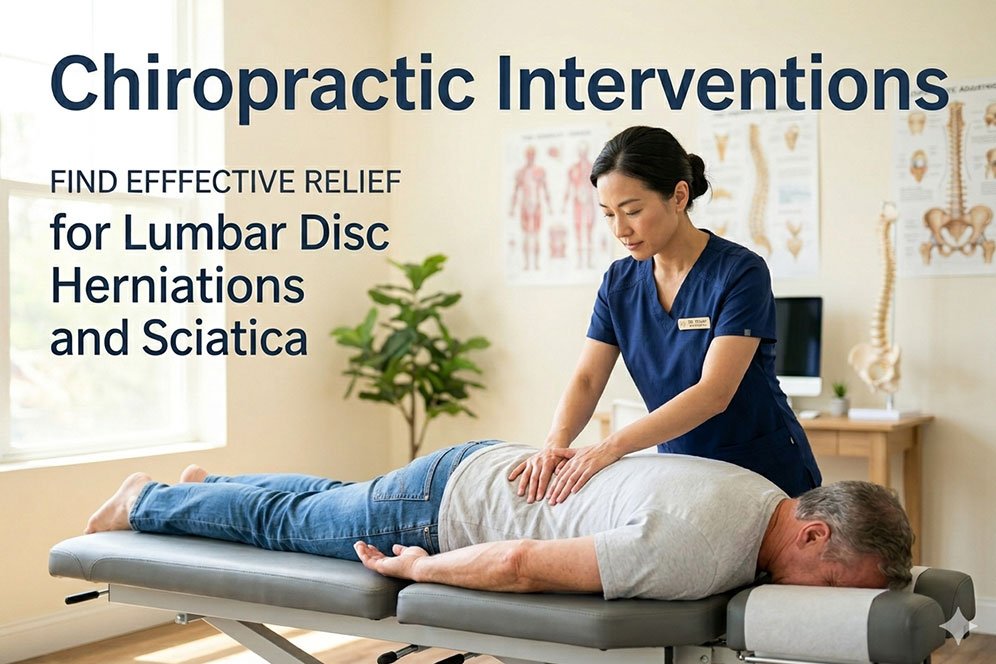
For many residents across the Greater Toronto Area, severe lower back pain accompanied by a sharp, shooting pain down the leg is a terrifying and debilitating experience. This specific symptom pattern—commonly referred to as sciatica—is frequently caused by a lumbar disc herniation. When a spinal disc bulges or ruptures, it can place direct mechanical and chemical pressure on the delicate spinal nerve roots leaving the lower back.
The pain from a herniation can make simple, everyday movements like putting on shoes, sitting at an office desk, or getting into a car feel nearly impossible. Historically, many patients believed that their only options for relief were long-term prescription painkillers or invasive spinal surgery.
Fortunately, modern clinical biomechanics offers a highly effective, non-surgical alternative. By utilizing targeted non-surgical spinal decompression strategies, specialized flexion-distraction mechanics, and proactive nerve root irritation management, chiropractors within our integrated paramedical network help patients reduce pain, restore movement, and avoid the operating room.
1. Anatomy of a Herniation: Mechanical and Chemical Irritation
To understand how a chiropractic treatment provides lasting relief, it is helpful to look at the anatomy of an intervertebral disc. Spinal discs act as shock-absorbing cushions between your vertebrae. Each disc consists of two main parts:
- Annulus Fibrosus: A tough, fibrous outer ring made of woven collagen layers.
- Nucleus Pulposus: A soft, jelly-like inner core that redistributes weight during movement.
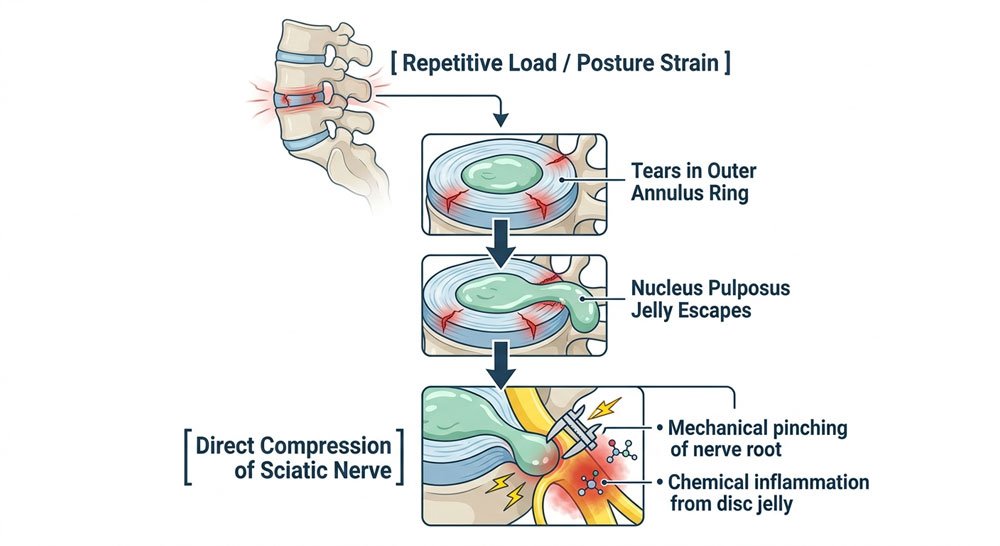
A lumbar disc herniation occurs when the tough outer ring develops tiny tears due to repetitive lifting strain, trauma, or prolonged slouched sitting. The soft, inner jelly core can then push through these tears, bulging outward into the spinal canal.
When this happens, the nerve root is irritated in two distinct ways. First, mechanical compression occurs as the bulging disc material physically pinches the nerve against the surrounding bone. Second, chemical inflammation sets in because the inner jelly core contains highly irritating proteins. When these proteins leak onto the nerve root, they trigger a severe inflammatory response, causing a sharp, burning pain to shoot down the pathway of the sciatic nerve—spanning the buttock, thigh, calf, and foot.
2. Flexion-Distraction Mechanics: The Non-Surgical Decompression Solution
Standard manual manipulations that use a fast, twisting thrust (HVLA adjustments) are often inappropriate or uncomfortable for a patient dealing with an acute, highly sensitive disc herniation. Instead, clinicians utilize a specialized, gentle technique called Cox Flexion-Distraction Therapy.
This evidence-based intervention requires a custom-engineered treatment table with a moveable lower section that drops and moves independently from the upper section. The patient lies face down, and the clinician firmly secures the specific spinal segment just above the herniation.
Using a manual lever, the therapist slowly lowers the bottom section of the table, gently stretching and opening up the lower spine. This specialized movement alters the fluid dynamics inside the injured lumbar spine through two primary mechanisms:
Creation of Negative Intradiscal Pressure
Gently separating the two vertebrae creates a vacuum effect—known as negative pressure—inside the injured disc space. This suction force helps gently pull the displaced, bulging inner jelly material away from the spinal canal and back toward the center of the disc, instantly reducing the mechanical pinching on the sciatic nerve.
Increasing the Intervertebral Foramen Height
The intervertebral foramen is the narrow bony doorway through which nerve roots exit the spine. Flexion-distraction physically increases the size of this opening by up to 28%. This extra space gives the swollen, inflamed nerve root immediate breathing room, drastically reducing radiating leg pain and numbness.
3. Comprehensive Management of Nerve Root Irritation
While reducing physical pressure on the nerve is an essential first step, a complete recovery program must also address the severe chemical inflammation and local muscle guarding that accompany a herniation.
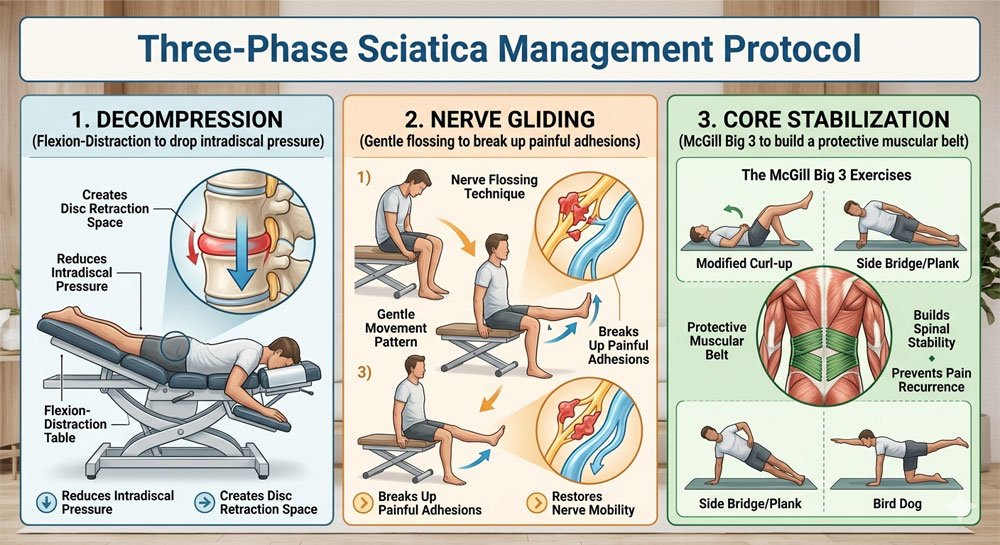
An integrated clinical treatment plan achieves this through a structured, multi-phase approach:
Passive Nerve Flossing (Neurodynamics)
As a nerve root remains inflamed, it can develop sticky scar tissue adhesions that bind it to the surrounding muscle layers. When you move, the nerve gets painfully yanked. Practitioners teach patients gentle nerve flossing exercises. These specific, rhythmic movements glide the nerve back and forth through its bony channel, breaking up restrictions and restoring smooth, pain-free nerve movement without stretching the sensitive nerve too tightly.
Building Progressive Core Stabilization
Once your acute pain is managed, treatment shifts toward protecting the lower back from future injury. Clinicians focus on strengthening your deep core muscles—such as the transverse abdominis and multifidus—which act as your body’s natural back brace.
Using evidence-based stability protocols like the McGill Big 3 exercises, patients learn to stabilize their lumbar spine using their muscles, preventing the micro-twisting movements that can damage vulnerable spinal discs.
Clinical Comparison: Decompression vs. Standard Adjustments
To help patients choose the safest, most effective approach for their condition, this matrix outlines the differences between standard adjustments and decompression therapy:
| Operational Feature | Flexion-Distraction Decompression | Standard Spinal Adjustment (HVLA) |
|---|---|---|
| Mechanical Action | Slow, repetitive, gentle spinal traction | Swift, localized, high-velocity manual thrust |
| Direction of Force | Flexion (bending) and long-axis traction | Rotation (twisting) or direct posterior push |
| Pressure Changes | Creates negative suction inside the disc | Creates brief compression followed by a release |
| Audible Cavitation | Very rare; stays within steady traction limits | Highly common; produces an audible “pop” |
| Clinical Focus | Ideal for disc herniations, sciatica, and stenosis | Best for facet joint stiffness and muscle spasms |
The Power of Coordinated Multidisciplinary Care
Overcoming a complex lumbar disc herniation requires a comprehensive approach that targets both the spinal joints and the surrounding soft tissues. Within our clinical network, we treat sciatica using a unified team model. While a chiropractor utilizes flexion-distraction to decompress the disc and relieve nerve pressure, a Registered Massage Therapist (RMT) can simultaneously work on the surrounding gluteal and hamstring muscles, releasing the painful muscle spasms triggered by the irritated nerve.
Every stage of your recovery is fully tracked and updated using secure digital charting (SOAP notes), ensuring your entire team stays perfectly aligned on your progress. If your symptoms are severe, our team can seamlessly coordinate with your family physician to manage your medical care or refer you for advanced diagnostic imaging like an MRI.
This collaborative strategy ensures that your spinal mechanics, muscular health, and nerve pathways are all safely addressed at once—giving you a fast, reliable path to recovery and helping you rebuild a strong, pain-free lower back.

Author: Henry Tse
Henry Tse, Founder and CEO of the RMT Clinic Network Organization—an integrated platform created to connect patients with trusted para-medical providers while helping practitioners build stronger, more profitable clinics using practical, real-world business systems. After launching, operating, and selling multiple wellness businesses, I repeatedly saw the same two challenges: patients struggled to find the right care close to them, while practitioners struggled to attract consistent bookings and build predictable, compliant, and sustainable businesses. I created the RMT Clinic ecosystem to solve both problems. Through our Canada-wide “near me” directory, specialized brand marketing solutions, and step-by-step training academy, we help patients discover qualified providers while giving Registered Massage Therapists and clinic owners the systems, tools, and strategies needed to turn their professional skills into scalable businesses. Core Values Innovation • Empowerment • Community Professional Background * Vice President and General Manager, Canadian Small Business Institute: 15 years as a senior business consultant and trainer. * Direct Marketing and Advertising, 1997–Present: Strategy, brand positioning, lead generation, and business development. * Wellness Clinic Owner and Operator, 2005–Present: Launched and operated nine clinics, with three active RMT clinics currently under management. If you are an RMT or clinic owner looking for more bookings, stronger...