
What to Expect During Your Initial Assessment with an Ontario RMT
When scheduling your first appointment at a professional massage therapy clinic in Ontario, the experience involves much more than simply climbing onto a treatment table. In Canada, particularly within Ontario’s heavily regulated healthcare system, Registered Massage Therapy (RMT) is classified as a regulated health profession under the Regulated Health Professions Act, 1991 (RHPA).
Because of this, an initial appointment always begins with a mandatory clinical evaluation. Whether you are visiting a local neighborhood health hub, an integrated rehabilitation facility, or a specialized clinic within the RMT Clinic Network, understanding what happens during your initial assessment ensures you are fully prepared for a safe, effective, and legally compliant healthcare experience.
Why Is an Initial Assessment Mandatory?
Every Registered Massage Therapist practicing in Ontario is governed by the College of Massage Therapists of Ontario (CMTO). The CMTO enforces strict Standards of Practice that dictate how a treatment plan must be formed. An RMT cannot legally provide manual soft-tissue therapy without first conducting a formal assessment.
This step acts as a foundational safety mechanism. It allows your therapist to screen for systemic contraindications (conditions where massage could cause physical harm, such as deep vein thrombosis or acute local infections), isolate the anatomical sources of your discomfort, and design an objective care baseline tailored specifically to your body.
Step 1: Complete Health History-Taking
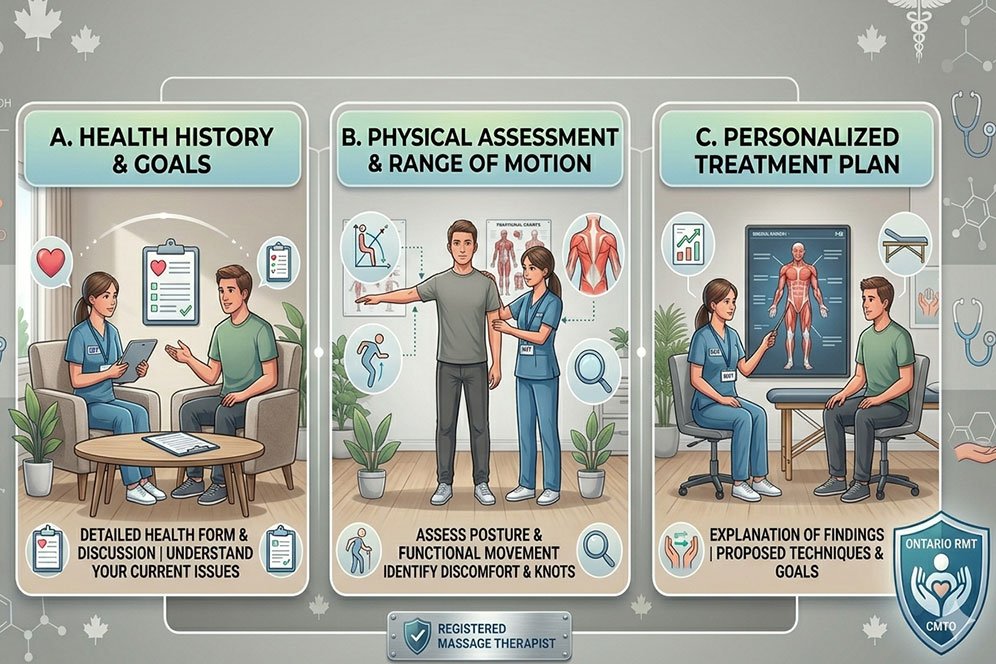
Your initial appointment begins with a comprehensive health history intake. This usually involves a digital form completed through secure, privacy-compliant platforms like JaneApp prior to your arrival, followed by a detailed verbal consultation with your therapist.
During this discussion, your practitioner will look closely at:
- Primary Complaint Analysis: The exact location, duration, intensity, and quality of your pain or restriction (e.g., whether a sensation is a dull muscle ache, a sharp nerve pinch, or fascial tightness).
- Medical History & Comorbidities: Past surgeries, fractures, joint replacements, cardiovascular conditions, or chronic systemic disorders like diabetes or arthritis.
- Pharmacological Screening: Any medications you are currently taking. For instance, muscle relaxants or blood thinners directly influence the pressure levels an RMT can safely apply to your deep tissues.
- Occupational and Lifestyle Stressors: Repetitive postural strains caused by prolonged desk work, heavy lifting, or regular athletic training.
Step 2: Advanced Orthopaedic Testing & Physical Assessment
Once your history-taking provides a clear systemic overview, your therapist moves into the physical examination. This is where massage therapy transitions from a generalized wellness service into an evidence-based clinical discipline.
Depending on your symptoms, your RMT will perform several types of physical assessments to pinpoint exactly which structures—muscles, tendons, ligaments, or nerves—are involved:
Postural and Visual Analysis
The therapist observes your natural static posture, looking for structural imbalances such as forward head translation, uneven shoulder heights, or pelvic tilts that may cause compensatory strain on surrounding muscle groups.
Range of Motion (ROM) Testing
To evaluate joint mobility and tissue health, your RMT guides you through three distinct phases of movement:
- Active ROM: You move the joint through its natural range yourself. This allows the therapist to evaluate your functional mobility, coordination, and pain boundaries.
- Passive ROM: The therapist moves your joint while your muscles are completely relaxed. This helps isolate deep joint capsule structures, ligaments, and non-contractile tissues.
- Resisted Isometric Testing: You hold a specific joint position while applying force against the therapist’s resistance. This directly evaluates the structural strength and pain response of specific contractile muscles and tendons.
Specialized Orthopaedic Tests
If you are dealing with distinct regional complaints—such as chronic sciatica, rotator cuff issues, or carpal tunnel symptoms—your therapist will perform highly specific orthopaedic tests. For example, they may use a straight-leg raise test to evaluate sciatic nerve tension, or specific shoulder maneuvers to check for rotator cuff tendon impingement.
Step 3: Establishing Informed Treatment Consent
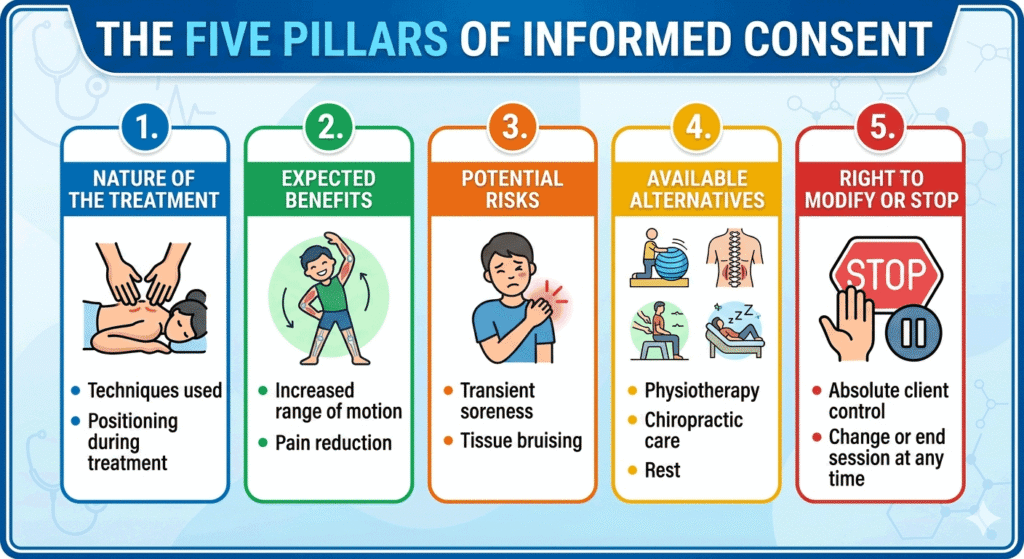
The final step before physical treatment can begin is establishing informed consent. Under Ontario’s Medical Consent Act, consent is a mandatory, continuous process. Your RMT must clearly present their clinical findings and explain exactly what they propose to do.
A legally valid informed consent discussion must explicitly cover these five components:
During this step, your therapist will also confirm your preferences regarding draping. In Ontario, strict regulations dictate that you must be securely covered with sheets or blankets at all times, with only the specific body part being actively treated left exposed. You maintain absolute control over your comfort level: treatments can be performed over your clothing, with partial undressing, or fully unclothed within secure draping parameters.
Remember: You have the absolute right to alter, pause, or completely halt a treatment at any time, for any reason, regardless of whether prior consent was given.
Step 4: Formulating Your Prescribed Plan of Care
With the assessment complete and consent explicitly documented, your therapist will guide you through the initial hands-on treatment session. Afterward, they will present a clear, forward-looking plan of care.
A comprehensive plan of care includes:
- Treatment Frequency: A structured recommendation on how often you should receive care to achieve your specific health goals (e.g., once per week for three weeks, followed by a clinical reassessment).
- Targeted Home Care: Customized homework, including specific stretching routines, progressive strengthening exercises, or hydrotherapy protocols (using ice or heat) to maintain your clinical gains between clinic visits.
- Cross-Disciplinary Referrals: If your assessment suggests that your recovery would benefit from skeletal alignment adjustments or active exercise rehabilitation, your RMT can coordinate care paths with local physiotherapists or chiropractors to ensure a well-rounded approach to your health.
By understanding what to expect during your initial assessment, you ensure that your path toward pain relief and functional recovery is safe, efficient, and fully aligned with Ontario’s high standards of professional healthcare.

Author: Henry Tse
Founder & CEO, RMT Clinic Network Organization | Canada-wide “Near Me” Directory + Training Academy | Helping RMTs Build Profitable Clinics About: I’m Henry Tse—Founder & CEO of the RMT Clinic Network Organization, built to connect patients with trusted para-medical providers and to help practitioners grow clinics with real-world systems. After launching, operating, and selling multiple wellness businesses, I saw the same problem everywhere: patients struggle to find the right care, and practitioners struggle to build predictable, compliant, sustainable businesses. I created the RMTClinic ecosystem to solve both—through a Canada-wide “near me” directory, brand marketing solutions, and step-by-step training that turns skill into a scalable clinic. Core values: Innovation • Empowerment • Community Background highlights: VP & GM, Canadian Small Business Institute — 15 years (Senior Consultant & Trainer) 1997–Present: Direct Marketing & Advertising (strategy, positioning, lead generation) 2005–Present: Owner/Operator (9 clinics total; currently 3 active RMT clinics) If you’re an RMT or clinic owner who wants more bookings, stronger brand visibility, and a repeatable growth system—let’s connect.