

What is a Chiropractic Adjustment? The Science of Joint Mobilization
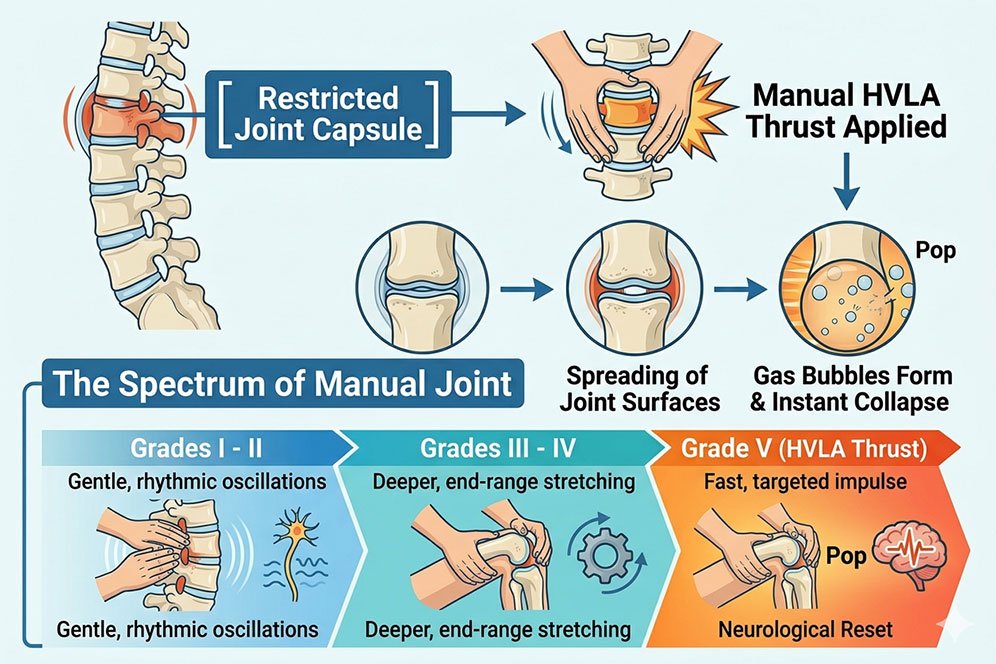
For many people dealing with nagging lower back issues, neck stiffness, or tension headaches across Ontario, a visit to a manual therapist often involves a highly distinct experience: the quick, precise thrust of a joint manipulation, typically accompanied by an audible “pop” or “crack.” Known formally as a chiropractic adjustment—or a High-Velocity, Low-Amplitude (HVLA) thrust—this specialized intervention is widely used to restore mobility and alleviate pain.
Yet, despite its popularity, a substantial amount of mystery still surrounds the practice. Some assume the audible pop is the sound of bones grinding together, while others believe a therapist is physically pushing misaligned joints back into a straight line like building blocks.
In reality, the underlying mechanisms are entirely based on neurophysiology, fluid mechanics, and sensory nervous system pathways. Understanding the clinical science behind joint mobilization reveals why it serves as a powerful partner to soft-tissue therapies within an integrated paramedical network.
1. The Physics of the “Pop”: Understanding Joint Cavitation
The auditory release that occurs during a spinal adjustment can be startling, but it is a completely safe, predictable physical phenomenon known as joint cavitation. It is the exact same process that occurs when you crack your knuckles.
To understand how this works, we have to look inside the structure of a moveable joint, such as the facet joints connecting your spinal vertebrae. Every moveable joint is sealed within a protective, flexible capsule filled with synovial fluid, which acts as a lubricant to reduce friction during movement.
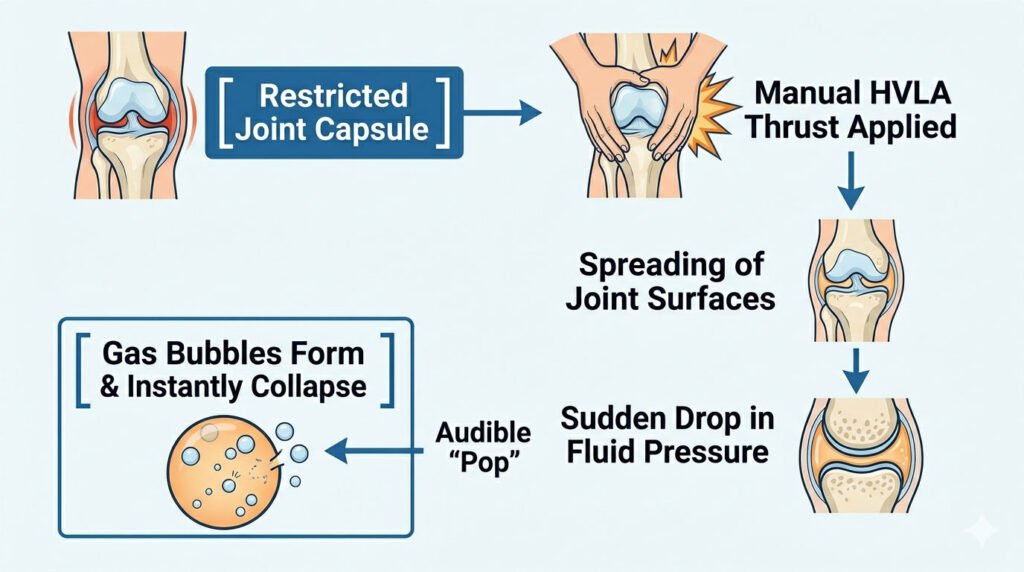
When a joint becomes restricted due to poor posture, repetitive strain, or muscle guarding, the joint capsule tightens. During an HVLA adjustment, the practitioner applies a swift, controlled stretch to the capsule, slightly separating the two joint surfaces.
This separation causes a sudden drop in pressure within the sealed joint envelope. Because of this pressure drop, dissolved gases naturally present within the synovial fluid (mostly carbon dioxide, nitrogen, and oxygen) rapidly draw out of the liquid, forming a tiny gas bubble.
The audible “pop” is the sound of this gas bubble forming and instantly collapsing within the fluid matrix. Once cavitation occurs, it takes roughly 20 minutes for the gases to fully dissolve back into the synovial fluid, which is why a joint cannot be audibly cracked twice in immediate succession.
2. Mechanoreceptor Activation and the Neurological Reset
While the sound of cavitation gets the most attention, the most substantial therapeutic benefits of an adjustment happen deep within your nervous system. Joint capsules and their surrounding ligaments are packed with specialized sensory nerve endings called mechanoreceptors.
Mechanoreceptors act as your body’s built-in motion sensors, constantly measuring joint speed, position, and physical tension. When a joint is stiff or locked up, these sensors go quiet. Without their input, your brain cannot accurately track what that part of your body is doing, prompting the surrounding muscles to tighten up in a protective spasm to prevent further injury.
When an adjustment stretches the joint capsule, it sends a massive, rapid wave of sensory data up through your spinal cord to your brain. This sudden surge of information triggers two vital neurophysiological responses:
1. Afferent Inhibition (The Pain Gate Mechanism)
The fast-moving sensory signals from the newly stimulated mechanoreceptors travel up your thickest, fastest nerve pathways. These signals hit the spinal cord much quicker than the slow, aching pain signals coming from irritated tissues. This effectively blocks the pain signals from reaching your conscious brain—a process known as the Gate Control Theory of Pain.
2. The Alpha-Motor Neuron Reflex Loop
This sudden rush of movement data essentially hits a “reset switch” within your central nervous system. The brain stops sending the constant nerve impulses that tell your surrounding muscles to tighten up, causing deep, guarded muscle spasms to instantly relax and let go.
3. Joint Mobilization vs. HVLA Adjustment: A Tiered Approach
Not every joint restriction requires a fast, popping thrust. Manual therapy utilizes a spectrum of movement techniques tailored to a patient’s comfort level, tissue irritability, and unique medical history.
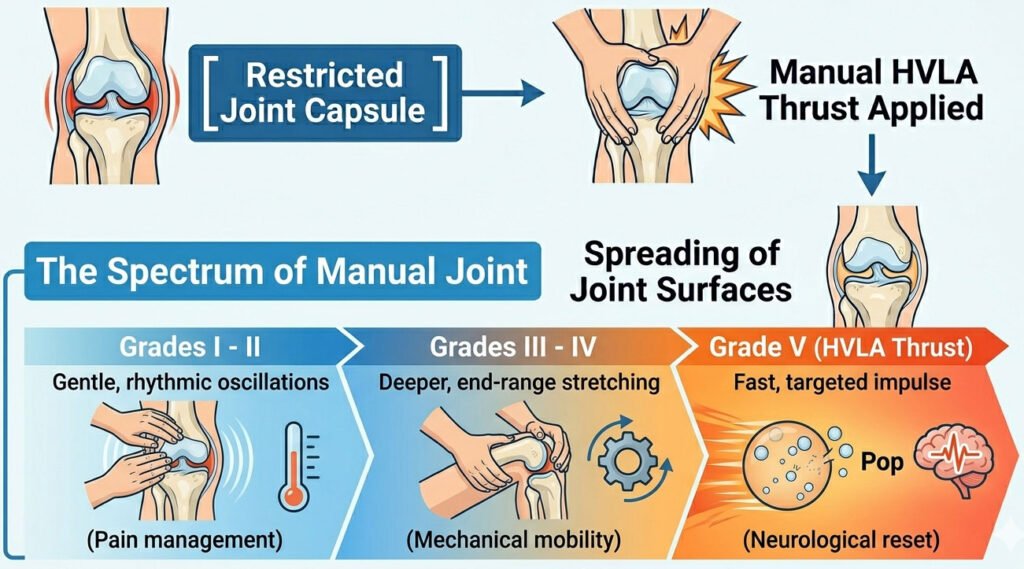
Practitioners categorize manual joint movements using a standardized 5-tier system known as Maitland’s Grades of Mobilization:
- Grades I and II (Gentle Mobilization): These involve slow, gentle, rhythmic movements within the joint’s comfortable, existing range of motion. They never reach the end-of-range barrier and are used primarily to soothe highly sensitive, acutely painful joints by gently stimulating local nerves without straining the tissues.
- Grades III and IV (Deep Mobilization): These movements push directly up against the rigid boundary of a restricted joint, stretching the stiff capsule and ligaments. They are used to break down physical stiffness and improve mechanical movement, without utilizing a sudden thrust.
- Grade V (The Adjustment / Manipulation): This is the classic chiropractic adjustment. It is a high-velocity, low-amplitude thrust delivered directly at the end-of-range barrier. It is designed to cause cavitation and trigger the neurological reflex reset outlined above.
Clinical Comparison: HVLA Adjustments vs. Low-Grade Mobilization
To help patients make informed decisions alongside their care providers, this matrix highlights how a fast thrust differs from slow joint stretching:
| Operational Feature | High-Velocity, Low-Amplitude (HVLA) Thrust | Low-Grade Joint Mobilization |
|---|---|---|
| Delivery Speed | Very rapid; completed in milliseconds | Slow, rhythmic, repetitive oscillations |
| Audible Cavitation | Common; gas bubbles form and collapse | Rare; stays well within fluid limits |
| Primary Goal | Neurological reset; breaks muscle spasm loops | Mechanical stretching; lowers local tissue hypersensitivity |
| Force Application | Short, sharp impulse over a tiny distance | Continuous, gentle push or pull |
| Clinical Suitability | Best for chronic stiffness and locked segments | Ideal for highly sensitive, acute, or fragile joints |
The Value of an Integrated Paramedical Approach
A chiropractic adjustment is an exceptionally efficient tool for resetting a locked joint and calming down the nervous system, but it rarely functions best as a standalone cure. Joints do not lock up in a vacuum; they are pulled out of alignment by chronically tight muscles and bound-up fascial sheets. Conversely, chronic joint stiffness causes the surrounding soft tissues to shorten and form tight knots over time.
This is why an integrated treatment strategy is incredibly effective. By combining joint manipulations with targeted soft-tissue therapies—such as specialized myofascial release, medical acupuncture, or progressive physiotherapy exercises—practitioners can address both the bone and muscle components of an injury simultaneously.
Ensuring every provider documents your functional progress using secure digital charting (SOAP notes) guarantees your entire care team stays perfectly aligned. This collaborative approach addresses the structural joints, the soft tissues, and the movement patterns all at once, providing a fast path to recovery and a lasting foundation for pain-free movement.

Author: Henry Tse
Henry Tse, Founder and CEO of the RMT Clinic Network Organization—an integrated platform created to connect patients with trusted para-medical providers while helping practitioners build stronger, more profitable clinics using practical, real-world business systems. After launching, operating, and selling multiple wellness businesses, I repeatedly saw the same two challenges: patients struggled to find the right care close to them, while practitioners struggled to attract consistent bookings and build predictable, compliant, and sustainable businesses. I created the RMT Clinic ecosystem to solve both problems. Through our Canada-wide “near me” directory, specialized brand marketing solutions, and step-by-step training academy, we help patients discover qualified providers while giving Registered Massage Therapists and clinic owners the systems, tools, and strategies needed to turn their professional skills into scalable businesses. Core Values Innovation • Empowerment • Community Professional Background * Vice President and General Manager, Canadian Small Business Institute: 15 years as a senior business consultant and trainer. * Direct Marketing and Advertising, 1997–Present: Strategy, brand positioning, lead generation, and business development. * Wellness Clinic Owner and Operator, 2005–Present: Launched and operated nine clinics, with three active RMT clinics currently under management. > If you are an RMT or clinic owner looking for more bookings,...