

Deep Tissue Massage Recovery Timeline: What is Normal Soreness vs. Unexpected Pain?
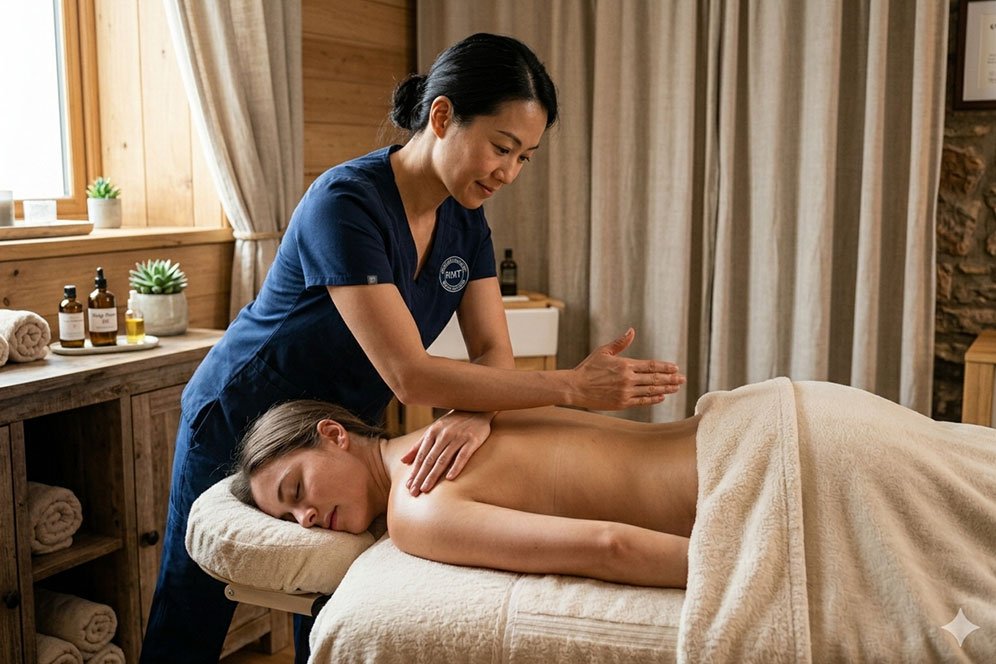
For patients seeking clinical symptom relief across Ontario, a deep tissue massage is often the go-to solution for chronic structural pain, posture imbalances, and athletic injuries. However, because this specific modality targets the deepest layers of connective tissue and muscle fibers, the immediate post-treatment window can surprise first-time patients.
A common question handled by our intake teams across the RMT Clinic Network is: “Is it normal to feel sore after a deep tissue massage, and how long should it last?”
Understanding the scientific metabolic processes behind muscle healing allows patients to navigate their recovery timelines with confidence. This guide breaks down the biological shifts that occur after deep manual manipulation, establishes a clear recovery baseline, and helps you distinguish between normal, productive tissue remodeling and unexpected, adverse pain.
The Biological Science of Deep Tissue Bodywork
To understand why your body feels sore following a clinical session, it is necessary to examine the microscopic environment of an overused, hypertonic (chronically tense) muscle group.
When a muscle undergoes repetitive strain—whether from sitting at a desk in downtown Toronto or training for a marathon—it develops structural micro-adhesions. These are dense bands of collagen fiber configurations that bind muscle layers together, restricting blood flow and trapping metabolic waste products.
During a deep tissue treatment, a Registered Massage Therapist (RMT) applies slow, targeted, high-friction mechanical load across the muscle fibers. This manual force intentionally breaks down those restrictive micro-adhesions.
This mechanical disruption triggers a localized, controlled inflammatory response. While “inflammation” is frequently viewed as negative, in a clinical rehabilitation context, it is the mandatory first stage of the body’s natural tissue remodeling loop:
- Micro-Trauma Activation: The physical pressure creates micro-tears in the hypertonic muscle fibers, similar to the tissue changes caused by heavy resistance weight training.
- Cellular Signalling: The body responds by releasing specialized signaling proteins called cytokines, which rapidly recruit white blood cells (macrophages and neutrophils) to the targeted area.
- Metabolic Cleansing: These cells clear out cellular debris and built-up metabolic waste while triggering the delivery of freshly oxygenated blood and essential amino acids.
- Collagen Synthesis: Fibroblasts migrate to the site to lay down new, parallel collagen strands, effectively restoring natural flexibility and structural length to the treated muscle group.
The Standard Deep Tissue Recovery Timeline
Because the body requires time to complete this metabolic lifecycle, physical recovery follows a predictable, structured progression over several days.
Hours 1 – 12: The Neurological Reprieve
Immediately following your treatment, you will likely experience a significant reduction in structural tightness and a notable increase in joint range of motion (ROM). This occurs because the deep manual pressure dampens overactive pain signals sent to the central nervous system, while inducing a state of parasympathetic relaxation.
Hours 12 – 36: Peak Post-Treatment Soreness
This is the phase where the localized inflammatory cascade peaks. It is entirely normal to feel a dull, diffuse ache when moving or touching the treated areas. This sensation is known clinically as Delayed Onset Muscle Soreness (DOMS). The tissue may feel heavy, tender, or warm, reflecting the increased metabolic activity occurring deep within the muscle layers.
Hours 36 – 72: Structural Remodeling and Resolution
The inflammatory response resolves as cellular cleanup finishes. The dull ache dissipates, replaced by enhanced tissue elasticity, reduced baseline pain, and a return to functional, un-restricted movement patterns.
Productive Remodeling Soreness vs. Adverse Pain
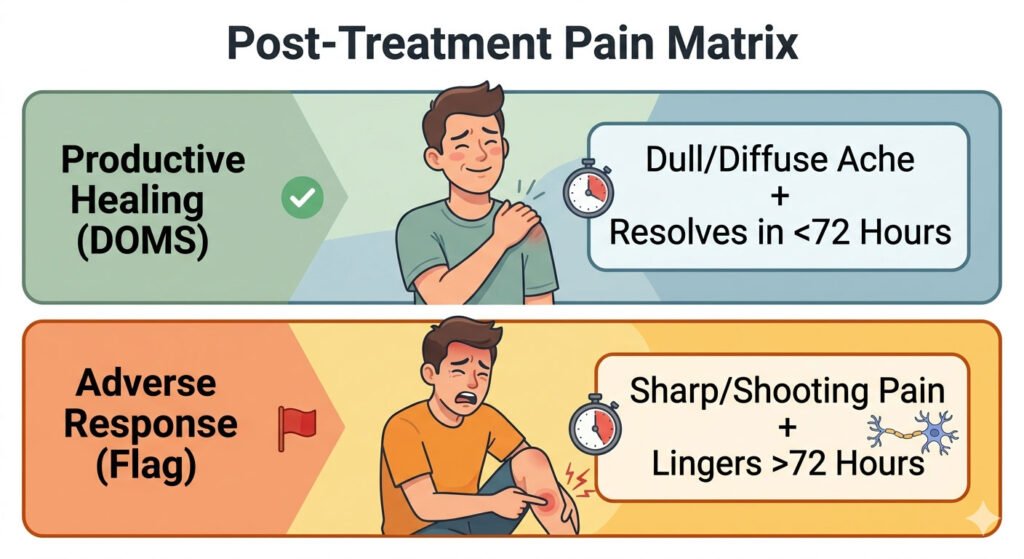
While localized soreness is a standard byproduct of deep soft-tissue therapy, it should never cross the line into actual injury. Every patient must monitor their post-treatment sensations using these strict diagnostic criteria:
Normal, Productive Soreness (DOMS)
- The Feeling: A dull, bruised, or generalized muscular ache, closely mimicking the feeling of an intense workout.
- Location: Broadly distributed across the specific muscle bellies that received direct treatment (e.g., the rhomboids or gluteals).
- Duration: Starts within 12 to 24 hours post-treatment and completely resolves on its own within 72 hours.
- Movement Impact: The ache lessens as you perform light movement, gentle stretching, or apply local hydrotherapy.
Unexpected, Adverse Pain
- The Feeling: A sharp, stabbing, electric, or shooting sensation that makes you reflexively flinch.
- Location: Pinpointed directly over a bone, nerve pathway, or joint capsule, rather than within the soft muscle belly.
- Duration: Lingers continuously with zero improvement beyond 72 to 96 hours.
- Systemic Red Flags: The presence of localized swelling, deep skin bruising, numbness, tingling down a limb, or a systemic fever.
Evidence-Based Home Care Protocols for Recovery
To optimize your body’s metabolic recovery timeline and minimize the duration of post-treatment soreness, implement these clinical home care strategies during the first 48 hours:
Flush Metabolic Waste
Hours 1 – 6: Targeted Rehydration
Drink extra water immediately following your session. Deep manual work mobilizes trapped fluid between fascial sheets, and adequate hydration is necessary to help your kidneys filter and excrete cellular debris.
Cryotherapy for Acute Tenderness
Hours 12 – 24: Vaso-Modulation
If an area feels uncomfortably warm or tender, apply an ice pack wrapped in a thin towel for 15 minutes. Cold induces local vasoconstriction, reducing excessive inflammatory swelling without halting the healing process.
Thermotherapy and Light Movement
Hours 24 – 48: Active Hyperemia
Once the initial acute soreness stabilizes, switch to a warm bath or a heating pad for 20 minutes, combined with low-impact walking. Heat causes vasodilation, flooding the remodeling tissue with fresh, nutrient-rich blood to accelerate muscle repair.
Managing Your Care Safely in Ontario
Every RMT practicing within our network is trained to systematically tailor their depth of pressure to stay within your physical tolerance, ensuring the tissue responds productively without causing guarding or micro-tearing.
If you ever experience post-treatment sensations that fall into the unexpected pain category, contact your clinic provider immediately. Your therapist will document these details within your secure, private EMR SOAP notes, allowing them to adjust your treatment plan, modify their manual techniques, or safely coordinate a direct cross-referral to an allied physiotherapist or chiropractor to support your ongoing recovery.

Author: Henry Tse
Henry Tse, Founder and CEO of the RMT Clinic Network Organization—an integrated platform created to connect patients with trusted para-medical providers while helping practitioners build stronger, more profitable clinics using practical, real-world business systems. After launching, operating, and selling multiple wellness businesses, I repeatedly saw the same two challenges: patients struggled to find the right care close to them, while practitioners struggled to attract consistent bookings and build predictable, compliant, and sustainable businesses. I created the RMT Clinic ecosystem to solve both problems. Through our Canada-wide “near me” directory, specialized brand marketing solutions, and step-by-step training academy, we help patients discover qualified providers while giving Registered Massage Therapists and clinic owners the systems, tools, and strategies needed to turn their professional skills into scalable businesses. Core Values Innovation • Empowerment • Community Professional Background * Vice President and General Manager, Canadian Small Business Institute: 15 years as a senior business consultant and trainer. * Direct Marketing and Advertising, 1997–Present: Strategy, brand positioning, lead generation, and business development. * Wellness Clinic Owner and Operator, 2005–Present: Launched and operated nine clinics, with three active RMT clinics currently under management. If you are an RMT or clinic owner looking for more bookings, stronger...