

Managing Chronic Tension Headaches Through Cervical Neuromuscular Massage

The Suboccipital Trigger Point Blueprint
For thousands of individuals across Ontario, chronic tension headaches are a debilitating barrier to daily productivity, focus, and overall quality of life. Whether you are navigating a high-stress corporate environment in downtown Toronto or spending long hours commuting across the Greater Toronto Area, these headaches typically manifest as a constant, dull, aching band of pressure wrapping around your forehead, temples, or the base of your skull.
While many people routinely rely on over-the-counter pain medications for temporary relief, these pharmaceuticals merely mask the symptoms without addressing the underlying physical cause. In the field of evidence-based clinical bodywork, an overwhelming majority of these chronic headaches are traced directly to specialized muscular knots, known as myofascial trigger points, located deep within the upper neck.
By utilizing Cervical Neuromuscular Massage, Registered Massage Therapists (RMTs) within the RMT Clinic Network can accurately isolate and deactivate these hyperirritated structures, offering a sustainable, non-pharmacological solution to chronic head pain.
Anatomy of the Headache Engine: The Suboccipital Muscular Complex
To understand why upper neck tension triggers pain across your forehead and eyes, we must look closely at the complex anatomy located right at the base of your skull. This area is home to the suboccipital muscular complex, a specialized group of four small, deep muscle pairs that bridge your highest cervical vertebrae (C1 and C2) to your occipital bone (the base of the skull):
- Rectus Capitis Posterior Major
- Rectus Capitis Posterior Minor
- Obliquus Capitis Superior
- Obliquus Capitis Inferior
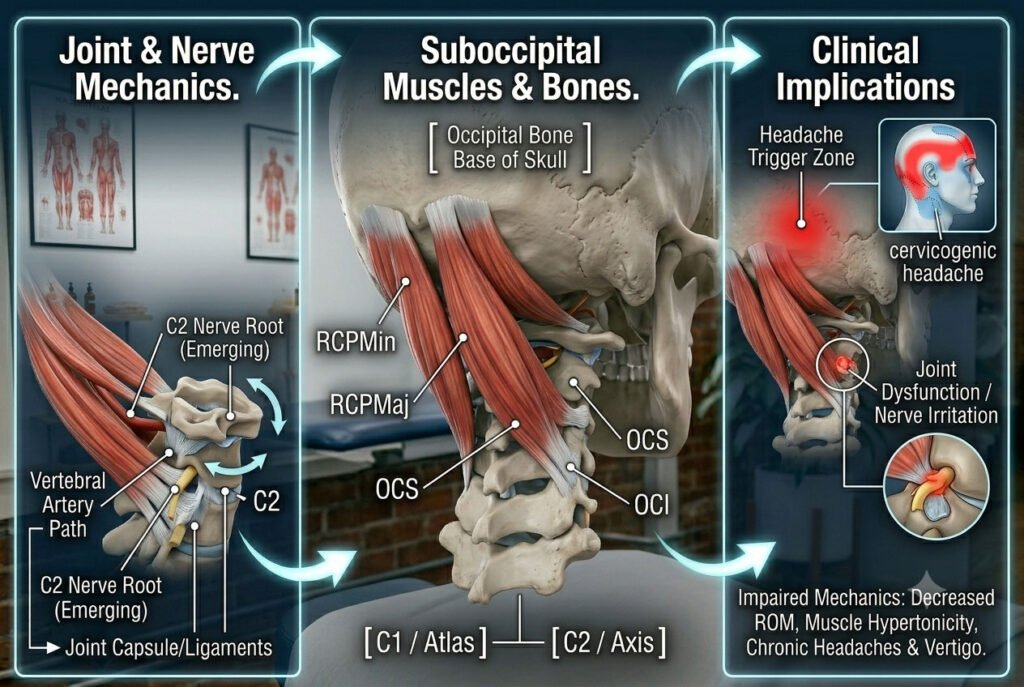
Despite their small size, these muscles perform highly critical structural and neurological jobs. They carry an incredibly high density of muscle spindles—specialized sensory receptors that detect changes in muscle length and position. This makes the suboccipitals the main communication highway responsible for tracking head posture and coordinating fine eye movements.
However, when you hold a forward-head posture at a desk, lean over a phone, or clench your jaw during stress, these tiny muscles must contract continuously to keep your head level against the pull of gravity. This intense, un-relaxed workload quickly creates local tissue starvation (ischemia), leading to the formation of painful, active trigger points.
Mapping Suboccipital Trigger Points and Referred Pain Pathways
A myofascial trigger point is a hyperirritable spot within a taut band of skeletal muscle that produces localized tenderness and refers pain to other parts of the body. The suboccipital complex contains specific trigger point locations that map perfectly to the standard distribution pattern of a classic tension headache.
The “Question Mark” Referred Pain Pathway
When trigger points in the suboccipital muscles are compressed or severely aggravated, they do not just hurt locally in the neck. Instead, they project a deep, dull ache in a distinct, loop-like pattern:
- It starts at the base of the skull (the occiput).
- It travels upward across the side of the head, behind and above the ear.
- It sweeps forward across the parietal bone to settle directly behind the eye and across the brow ridge.
This referred pain pathway mimics a giant question mark drawn on the side of your head. This phenomenon occurs because chronic suboccipital tension mechanically compresses and irritates the Greater Occipital Nerve, which winds directly through these muscle layers as it travels upward to provide sensation to your scalp.
Correcting Head Pain via Cervical Neuromuscular Massage
Cervical Neuromuscular Massage is an advanced, assessment-based clinical technique that uses precise manual pressure to normalize overactive nervous system signaling and restore resting muscle length. When treating tension headaches caused by suboccipital dysfunction, an RMT follows a structured protocol:
Step 1: Manual Palpation and Taut Band Isolation
Because the suboccipital muscles lie beneath thick superficial layers like the trapezius and splenius capitis, your therapist uses specialized, deep palpation techniques. They sink through the upper layers to locate the rigid, rope-like bands of tissue deep along the suboccipital ridge line.
Step 2: Precision Suboccipital Release (Ischemic Compression)
Once the exact trigger points are identified, the RMT applies slow, steady, localized finger pressure directly upward toward the base of the skull. This compression temporarily restricts local capillary blood flow.
During this hold, you may feel your familiar headache symptoms briefly replicate behind your eye. Within 30 to 90 seconds, the nervous system adapts, your brain stops signaling the muscle to spasm, and the knot begins to soften under the therapist’s fingertips.
Step 3: Passive Longitudinal Stretching
Following trigger point deactivation, the therapist gently cradles your head and performs a slow, passive upper cervical flexion stretch. This manual traction elongates the newly released muscle fibers, encouraging fresh, oxygenated, nutrient-rich arterial blood to flood the tissue and flush out trapped metabolic debris.
Clinical Overview: Headache Drivers At-A-Glance
For individuals tracking their symptoms and clinic owners structuring care programs, this diagnostic matrix helps identify the main soft-tissue contributors to chronic head pain:
| Targeted Muscle Group | Exact Trigger Point Location | Referred Pain Pattern | Primary Mechanical Cause |
|---|---|---|---|
| Suboccipital Complex | Deep space along the ridge at the base of the skull | “Question mark” pattern; pain behind the eye, brow ridge, and skull base | Forward head posture, text neck, eye strain |
| Upper Trapezius | Midpoint of the upper shoulder muscle curve | Posterolateral neck, traveling up to the temple and angle of the jaw | Slouching at computers, carrying heavy shoulder bags |
| Sternocleidomastoid (SCM) | Lower and mid-bellies of the thick muscle on the side of the neck | Forehead, deep ear pain, dizziness, and eyebrow pressure | Elevated breathing patterns from stress, holding phone to ear |
Integrating Home Care for Lasting Headache Relief
To maintain your progress between clinical treatments, implement this evidence-based home care routine whenever you feel tension building in your neck:
1.The Suboccipital Towel Decompression:10 Minutes.
Roll up a small hand towel into a firm cylinder. Lie flat on your back on a firm surface and place the rolled towel directly under the base of your skull, allowing your head to gently drape over the top. Completely relax your jaw and eyes, letting gravity apply a mild, passive release to the suboccipital ridge.
2.The Active Axial Chin Tuck:2 Sets of 10 Reps.
Look straight ahead. Without dropping your chin down toward your chest, slide your head straight back horizontally, as if pulling away from a wall. Hold the backward position for 3 seconds to actively stretch the suboccipitals while strengthening the deep muscles at the front of your neck.
3.Hydrotherapy Modulation:15 Minutes.
Apply a damp heating pad or a warm compress directly to the back of your neck. The localized heat expands blood vessels, bringing fresh nutrients to the healing tissues and helping to prevent the central nervous system from re-triggering protective muscle spasms.
Experience Advanced, Integrated Headache Management
Resolving persistent tension headaches requires a careful blend of precise, targeted soft-tissue therapy and active postural awareness. Every session within the RMT Clinic Network is fully documented in secure digital health charts (SOAP notes), allowing your therapist to precisely track changes in your neck mobility, trigger point sensitivity, and headache frequency.
If your tension headaches are accompanied by severe jaw clenching (TMJ dysfunction) or spinal alignment issues, our therapists can seamlessly coordinate your treatment plan with local chiropractors or physiotherapists. This collaborative, cross-disciplinary approach ensures that every variable contributing to your pain—from structural joint alignment to deep muscular knots—is completely optimized, helping you reclaim a clear, focused, and pain-free life.

Author: Henry Tse
Henry Tse, Founder and CEO of the RMT Clinic Network Organization—an integrated platform created to connect patients with trusted para-medical providers while helping practitioners build stronger, more profitable clinics using practical, real-world business systems. After launching, operating, and selling multiple wellness businesses, I repeatedly saw the same two challenges: patients struggled to find the right care close to them, while practitioners struggled to attract consistent bookings and build predictable, compliant, and sustainable businesses. I created the RMT Clinic ecosystem to solve both problems. Through our Canada-wide “near me” directory, specialized brand marketing solutions, and step-by-step training academy, we help patients discover qualified providers while giving Registered Massage Therapists and clinic owners the systems, tools, and strategies needed to turn their professional skills into scalable businesses. Core Values Innovation • Empowerment • Community Professional Background * Vice President and General Manager, Canadian Small Business Institute: 15 years as a senior business consultant and trainer. * Direct Marketing and Advertising, 1997–Present: Strategy, brand positioning, lead generation, and business development. * Wellness Clinic Owner and Operator, 2005–Present: Launched and operated nine clinics, with three active RMT clinics currently under management. > If you are an RMT or clinic owner looking for more bookings,...