

Massage Therapy for Desk-Workers Experiencing Postural Strain: The Upper Trapezius Solution

For thousands of corporate professionals across Ontario—from the financial boardrooms of downtown Toronto to the tech hubs of Waterloo—the modern workday is defined by prolonged sitting. While office work may not seem physically demanding, spending eight to ten hours a day hunched over a laptop, typing at a keyboard, and peering at monitors places an immense, unnatural structural load on the musculoskeletal system.
Over time, this sedentary routine leads to a distinct pattern of physical dysfunction known clinically as postural strain injury or Upper Cross Syndrome. At the absolute center of this structural breakdown is chronic tightness in the upper trapezius muscles.
For clinic operators within the RMT Clinic Network and patients seeking lasting relief, understanding the biomechanical causes of desk-worker strain is the first step toward effective recovery. This article explores why the upper trapezius muscle becomes hypertonic (chronically overactive) and provides evidence-based home-care stretch interventions designed to restore balance to your upper body.
The Biomechanics of Desk Strain: Why the Upper Trapezius Overworks
The upper trapezius is a large, triangular muscle that runs from the base of your skull (occiput), down the back of your neck, and attaches across the top of your shoulder blade (scapula) and collarbone (clavicle). Under optimal conditions, its primary jobs are to elevate the shoulder blades, help rotate the shoulder blade upward when you lift your arm, and assist in extending and turning your neck.
However, when you sit at a desk and lean forward toward a computer screen, your body undergoes an immediate biomechanical shift:
- Forward Head Translation: For every inch your head drifts forward past its natural alignment over your shoulders, its relative weight increases by roughly 10 pounds. The upper trapezius must work constantly to prevent your head from dropping completely forward against gravity.
- Ischemic Muscle Contraction: Because this forward-leaning posture is maintained for hours at a time, the upper trapezius remains in a state of continuous, low-grade physical contraction. This constant tension squeezes local capillaries, cutting off oxygen delivery (ischemia) and trapping cellular metabolic waste products, which ultimately leads to painful trigger points.
- Reciprocal Muscle Weakness: As the upper trapezius becomes short, tight, and hypertonic, the opposing stabilizing muscles in your mid-back—specifically the rhomboids and lower trapezius—become overstretched, weak, and functionally inhibited.
This muscle imbalance creates a painful cycle: chronic muscle tightness leads to deep aches, reduced neck mobility, and tension headaches that radiate from the base of the skull around to the temples.
How Registered Massage Therapy Corrects Postural Strain
Simply rubbing a sore neck provides only temporary relief. To achieve lasting physical improvement, a Registered Massage Therapist (RMT) utilizes a systematic, assessment-based approach to break down the underlying structural dysfunction:
1. Ischemic Compression and Trigger Point Therapy
An RMT locates the hypersensitive, knotted bands of muscle fibers within the upper trapezius. By applying direct, sustained digital pressure (ischemic compression), the therapist temporarily restricts local blood flow. When this manual pressure is released, a fresh wave of oxygenated arterial blood rushes into the tissue, flushing out built-up cellular waste products and immediately lowering local pain receptor activity.
2. Myofascial Release (MFR)
The dense connective tissue (fascia) wrapping around your neck and shoulder muscles naturally thickens and glues together after months of poor posture. RMTs use broad, slow shearing forces to stretch and lengthen these restricted fascial sheets, restoring the smooth sliding mechanics required for pain-free neck movement.
3. Neuromuscular Re-education
Using advanced techniques such as Proprioceptive Neuromuscular Facilitation (PNF), your therapist can reset the overactive nervous system signals holding the upper trapezius in a shortened state, making it much easier to adopt a neutral, upright posture.
Targeted Home-Care Interventions: The 3-Step Desk Recovery Plan
To lock in the structural gains achieved during your clinical massage sessions, you must actively retrain your body at home or at the office. Implement these three evidence-based interventions daily to decompress your upper trapezius and re-engage your stabilizing muscles:
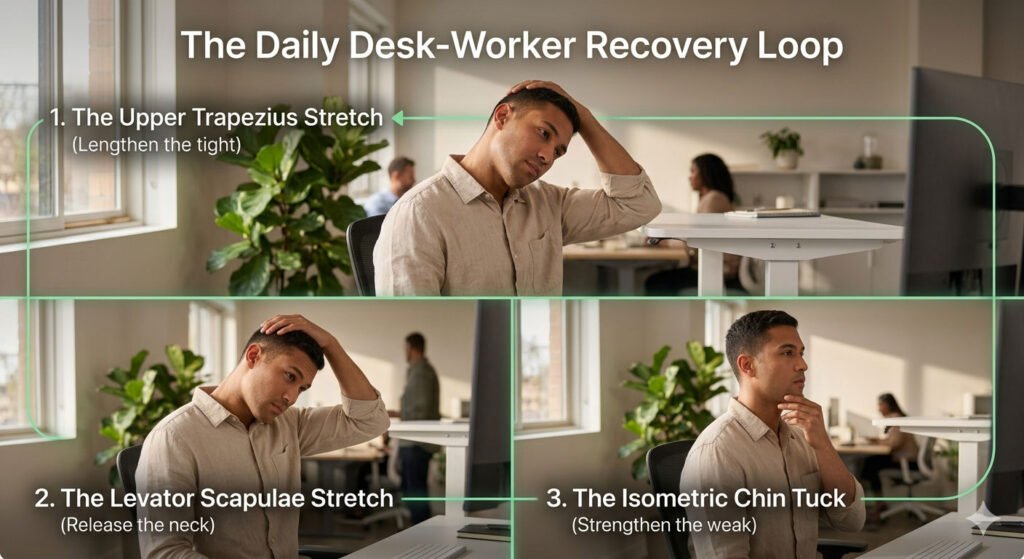
1. The Upper Trapezius Axial Elongation Stretch
- How to Perform It: Sit upright in an office chair. Anchor your right hand firmly under the seat of the chair to keep your right shoulder pinned down. Gently drop your left ear toward your left shoulder. For a deeper stretch, place your left hand lightly on the right side of your head and apply a very gentle, steady guidance down to the left.
- Hold Time: Maintain this position for 30 seconds, breathing deeply. Repeat twice on each side.
- The Science: Anchoring your hand prevents the shoulder blade from riding upward, ensuring a pure, isolated elongation of the hypertonic muscle fibers.
2. The Levator Scapulae “Pocket” Stretch
- How to Perform It: Sit tall and anchor your right hand under the chair seat. Turn your head 45 degrees to the left, pointing your chin down toward your left armpit (as if looking into your shirt pocket). Place your left hand over the back of your head and gently draw your head downward.
- Hold Time: Hold for 30 seconds. Perform 2 repetitions per side.
- The Science: This targets the levator scapulae, a deep neck muscle that works alongside the upper trapezius and frequently causes acute, localized neck stiffness when shortened.
3. The Isometric Chin Tuck (Deep Neck Flexor Activation)
- How to Perform It: Look straight ahead. Without tilting your head down toward your chest, pull your chin straight back, as if you are trying to make a “double chin” or pull your head away from a wall. Hold the backward position for 5 seconds, then relax.
- Repetitions: Complete 3 sets of 10 repetitions every afternoon.
- The Science: This movement actively strengthens the deep cervical flexors at the front of your neck, reversing forward head translation and structurally unloading the upper trapezius.
Clinical Differentiation: Postural Strain At-A-Glance
For corporate wellness coordinators and individuals looking to optimize their workstations, understanding the distinct states of tissue dysfunction helps direct the right clinical response:
| Structural Status | Muscle Groups Involved | Physical Sensation | Primary Clinical Action |
|---|---|---|---|
| Hypertonic & Shortened | Upper Trapezius, Levator Scapulae, Pectoralis Major | Sharp tightness, localized knots, tension headaches | Ischemic compression, myofascial release, static stretching |
| Inhibited & Overstretched | Rhomboids, Lower Trapezius, Deep Neck Flexors | Dull, burning ache between the shoulder blades | Target strengthening, PNF activation, posture retraining |
Building a Sustainable, Pain-Free Workday
Resolving chronic postural strain requires a combination of regular hands-on manual therapy and consistent home-care mechanics. Every clinical session within the RMT Clinic Network is backed by secure, private digital health records (SOAP notes) that track your neck range of motion and tissue improvements over time.
If your structural strain is complicated by spinal joint restrictions or chronic nerve irritation, our therapists can seamlessly coordinate care with local chiropractors or physiotherapists. This collaborative approach ensures that your soft tissue restrictions, spinal alignment, and active movement patterns are all fully optimized—giving you the structural support needed to work comfortably, productively, and completely pain-free.

Author: Henry Tse
Henry Tse, Founder and CEO of the RMT Clinic Network Organization—an integrated platform created to connect patients with trusted para-medical providers while helping practitioners build stronger, more profitable clinics using practical, real-world business systems. After launching, operating, and selling multiple wellness businesses, I repeatedly saw the same two challenges: patients struggled to find the right care close to them, while practitioners struggled to attract consistent bookings and build predictable, compliant, and sustainable businesses. I created the RMT Clinic ecosystem to solve both problems. Through our Canada-wide “near me” directory, specialized brand marketing solutions, and step-by-step training academy, we help patients discover qualified providers while giving Registered Massage Therapists and clinic owners the systems, tools, and strategies needed to turn their professional skills into scalable businesses. Core Values Innovation • Empowerment • Community Professional Background * Vice President and General Manager, Canadian Small Business Institute: 15 years as a senior business consultant and trainer. * Direct Marketing and Advertising, 1997–Present: Strategy, brand positioning, lead generation, and business development. * Wellness Clinic Owner and Operator, 2005–Present: Launched and operated nine clinics, with three active RMT clinics currently under management. > If you are an RMT or clinic owner looking for more bookings,...