

Dynamic Warm-Ups vs. Static Stretching for Athletic Injury Prevention: A Biomechanical Assessment

For decades, athletes across Ontario, from weekend warriors in Toronto to competitive players in the GTA, have followed a pre-game ritual: hold a static stretch for 30 seconds, feel the burn, and assume you are ready to play. It was long believed that stretching a “cold” muscle prevented pulls and tears.
However, modern sports science has completely rewritten the script on injury prevention. Research in biomechanics now confirms that traditional, passive, static stretching—the kind where you reach for your toes and hold still—can actually decrease explosive performance and may not reduce injury risk when performed immediately before a game.
Today’s gold standard is the Dynamic Warm-Up. This article will provide a technical assessment of why movement-based preparation is superior, exploring the complex interplay of tendon elasticity, muscle spindle activation, and nervous system preparation.
1. The Biomechanical Problem with Pre-Activity Static Stretching
To understand why static stretching has fallen out of favor for warm-ups, we must look at how it affects the mechanical properties of your muscle-tendon unit.
A standard static stretch puts a muscle and its attached tendon under a low-load, long-duration force. While this is effective at temporarily increasing joint range of motion, it introduces several negative mechanical changes that are counterproductive for athletic movement:
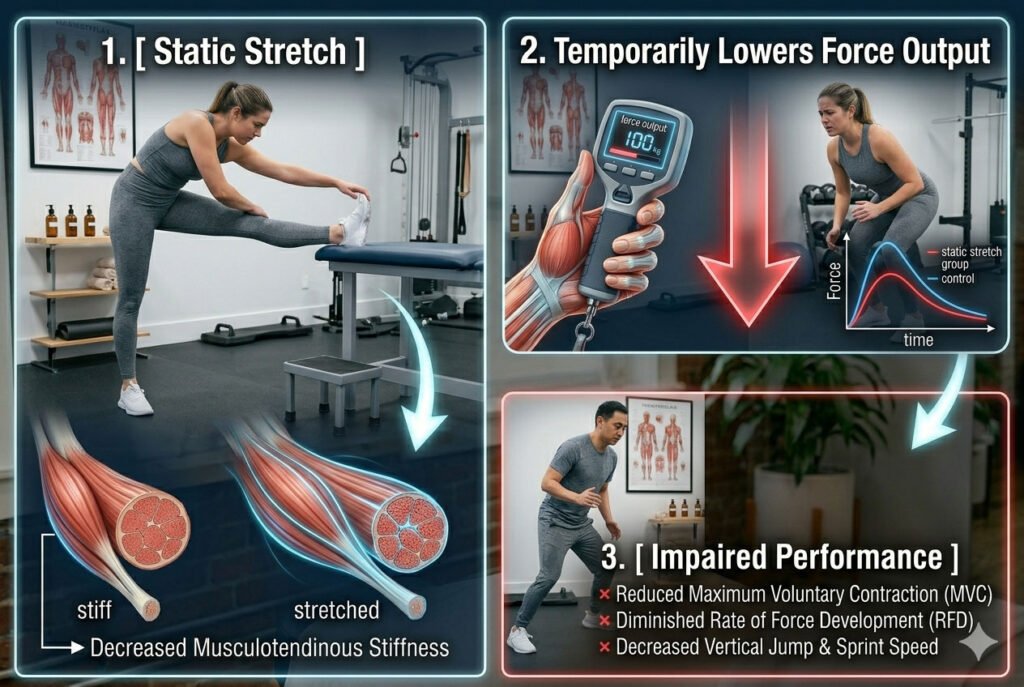
When you hold a deep stretch, the viscoelastic properties of the tendon change. The tendon becomes temporarily softer, looser, and less stiff. In biomechanics, this is known as “creeping.” While a “soft” tendon sounds positive, for performance, it is detrimental.
An athlete needs a relatively stiff, elastic tendon to function like a tight spring, storing and releasing massive energy during sprinting, jumping, or cutting. A loosened, stretched-out tendon cannot transfer force efficiently from the muscle to the bone, resulting in slower reaction times and reduced explosive power.
2. Dynamic Warm-Ups: Optimizing the Neuromuscular Blueprint
A dynamic warm-up involves performing controlled, movement-specific exercises that gradually increase in intensity, effectively mirroring the physical demands of the upcoming sport. Think leg swings, high knees, butt kicks, and walking lunges.
The superiority of this movement-based prep is rooted in three key physiological mechanisms:
Mechanical Stimulation of Tendon Elasticity
Instead of passively relaxing the tissue, dynamic movements rhythmically load and unload the tendon. This mechanical stress increases the temperature within the joint and stimulates the creation of localized hyaluronic acid, a vital joint lubricant. This process primes the tendon to act as an efficient, elastic spring, ready to absorb and return impact energy safely.
Nervous System Preparation (Potentiation)
A dynamic warm-up actively engages the central nervous system. As an athlete moves through complex, controlled patterns, their brain must activate specific motor units, coordinate muscle firing sequences, and adjust to balance changes. This process, known as Post-Activation Potentiation (PAP), effectively “wakes up” the neural pathways. It pre-paves the road between the brain and the muscle, ensuring faster, more accurate muscle contractions during competition.
Managing the Muscle Spindle Activation
Muscle spindles are specialized sensory receptors located within the belly of a muscle. They act as “motion sensors,” measuring how fast and how far a muscle is stretching. When a spindle detects a sudden, aggressive stretch, it triggers the Stretch Reflex, ordering the muscle to immediately contract to prevent a tear.
- Static Stretching: Overrides this safety mechanism. Passive stretching turns off or sedates the muscle spindle, leaving the muscle temporarily unguarded.
- Dynamic Stretching: Operates with the spindle. It uses the Stretch Reflex dynamically. During a leg swing, the hamstring spindle activates the opposing quad muscle at the end-range, actively helping to stabilize the joint through its full available range.
Clinical Overview: Dynamic vs. Static Preparation
For athletes, coaches, and clinic managers evaluating pre-game routines, this matrix summarizes the divergent physiological impacts of the two preparation methods:
| Physiological Marker | Pre-Activity Static Stretching | Pre-Activity Dynamic Warm-Up |
|---|---|---|
| Muscle-Tendon Stiffness | Decreases (Loosens the spring) | Increases (Primes the spring) |
| Nervous System | Sedative/Calming | Stimulant/Excitory |
| Muscle Spindle Function | Inhibited (Temporarily unguarded) | Activated (Active stabilization) |
| Body Temperature | Localized cooling or neutral | Systematic increase (Optimal viscosity) |
| Force & Power Output | Temporarily Decreased | Temporarily Increased |
Integrating RMT Clinic Support for Athletic Recovery
While a dynamic warm-up is the undisputed winner for pre-game preparation, static stretching still has a vital role in long-term athletic health—specifically within the post-training recovery phase and professional clinical care.
Years of explosive, high-intensity competition inevitably create muscular micro-trauma, bound-up fascial adhesions, and deep chronic tension patterns. These structural restrictions cannot be fully resolved by a dynamic warm-up alone. They require a focused recovery strategy to permanently remodel the tissue and restore a normal resting muscle length.
Within the RMT Clinic Network, our Registered Massage Therapists (RMTs) work collaboratively with Ontario’s athletes. While our manual therapy protocols are ideal during the recovery phase to break down scar tissue and lower resting tension, our primary focus is helping patients optimize their active warm-up strategy. By integrating expert manual soft-tissue support with a biomechanically sound dynamic routine, our team provides the comprehensive, evidence-based physical blueprint that athletes across the GTA need to maintain elite performance, prevent injury, and stay in the game long-term.

Author: Henry Tse
Henry Tse, Founder and CEO of the RMT Clinic Network Organization—an integrated platform created to connect patients with trusted para-medical providers while helping practitioners build stronger, more profitable clinics using practical, real-world business systems. After launching, operating, and selling multiple wellness businesses, I repeatedly saw the same two challenges: patients struggled to find the right care close to them, while practitioners struggled to attract consistent bookings and build predictable, compliant, and sustainable businesses. I created the RMT Clinic ecosystem to solve both problems. Through our Canada-wide “near me” directory, specialized brand marketing solutions, and step-by-step training academy, we help patients discover qualified providers while giving Registered Massage Therapists and clinic owners the systems, tools, and strategies needed to turn their professional skills into scalable businesses. Core Values Innovation • Empowerment • Community Professional Background * Vice President and General Manager, Canadian Small Business Institute: 15 years as a senior business consultant and trainer. * Direct Marketing and Advertising, 1997–Present: Strategy, brand positioning, lead generation, and business development. * Wellness Clinic Owner and Operator, 2005–Present: Launched and operated nine clinics, with three active RMT clinics currently under management. > If you are an RMT or clinic owner looking for more bookings,...