
RMT Guidelines for Sports Injury Rehabilitation: Healing Sub-Acute Strains
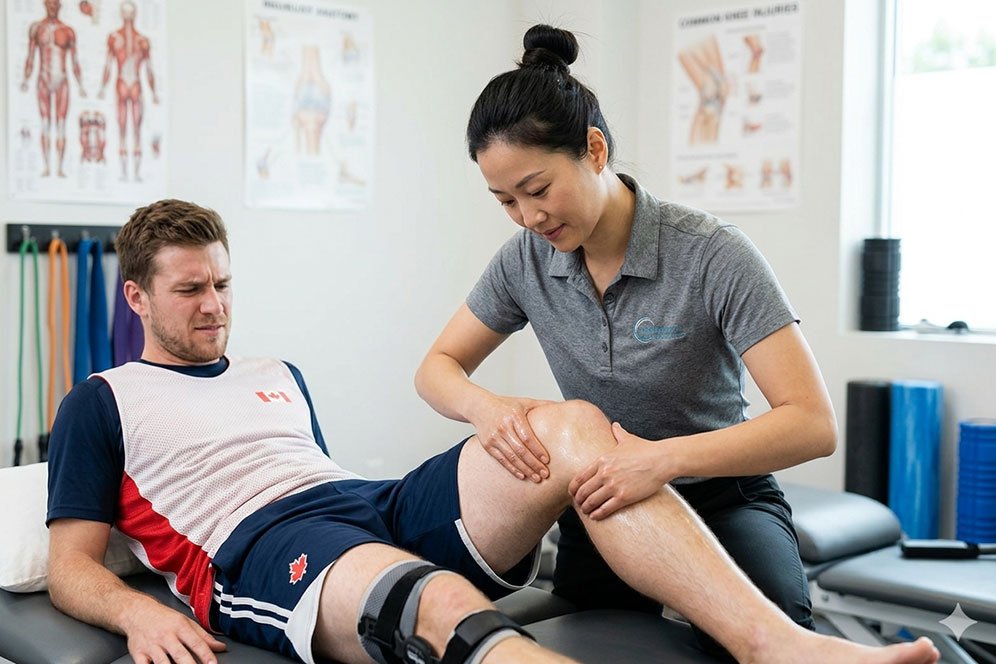
For athletes and active individuals across Ontario, suffering a sports injury can be incredibly frustrating. Whether it is a hamstring strain sustained on a soccer field in Mississauga or a rotator cuff tweak from a volleyball league in North York, recovery requires an evidence-based roadmap.
When a muscle injury transitions from the immediate, acute phase into the sub-acute phase (typically 3 to 21 days post-injury), manual therapy becomes a crucial part of the rehabilitation process. In Canada’s highly regulated healthcare environment, Registered Massage Therapists (RMTs) follow strict clinical protocols to transition damaged tissues from an injured state back to high-performance output.
This article explores the clinical science of how targeted sports massage therapy addresses fascial restrictions, accelerates localized circulation, and restores functional range of motion (ROM) following sub-acute muscle strains.
Understanding the Sub-Acute Phase of a Sports Injury
When a muscle is strained, its structural fibers are physically overstretched or torn.
- The Acute Phase (Days 1–3): The body focuses on protection. This stage is marked by swelling, severe inflammation, and pain at rest. Manual therapy directly over the injury site is contraindicated during this brief window.
- The Sub-Acute Phase (Days 3–21): The initial swelling stabilizes, and the body begins active tissue repair. Specialized cells called fibroblasts migrate to the injury site to deposit a chaotic network of collagen, commonly known as scar tissue.
While scar tissue is necessary to patch structural gaps in the muscle, it is naturally weak, rigid, and disorganized. If left unmanaged, this fibrous matrix adheres to surrounding tissues, creating permanent mechanical imbalances, persistent stiffness, and an elevated risk of re-injury.
1. Targeting and Releasing Fascial Restrictions
Fascia is a continuous, dense web of connective tissue that wraps around every muscle fiber, bundle, and individual organ in the human body. In a healthy state, fascia is highly elastic, allowing muscle layers to glide smoothly past one another during complex movements.
Following a sub-acute sports strain, the body’s localized inflammatory response thickens the surrounding interstitial fluid, gluing these fascial layers together. This forms dense fascial restrictions that act like a tight internal straightjacket around the recovering muscle group.
Registered Massage Therapists utilize specialized myofascial release (MFR) and deep tissue friction techniques to address these restrictions:
- Shearing Forces: RMTs apply steady, sustained physical pressure across or parallel to the restricted muscle boundaries.
- Piezoelectric Effect: The mechanical pressure and warmth generated by the therapist’s hands change the physical state of the ground substance within the fascia, shifting it from a thick, gelatinous state to a fluid, pliable one.
- Adhesion Breakdown: Breaking up these structural cross-links ensures that recovering muscle groups (such as the quadriceps or calves) can slide independently without pulling on surrounding joint capsules.
2. Optimizing Localized Circulation for Cellular Repair
Healthy muscle tissue relies on a rich, constant blood supply to bring in nutrients and clear out metabolic byproducts. However, sub-acute scar tissue is naturally avascular—meaning it lacks a robust network of blood capillaries. Furthermore, the surrounding muscle guarding often pinches nearby blood vessels, slowing down local circulation.
Sports massage therapy directly resolves this issue by manipulating local fluid dynamics through two primary pathways:
Micro-Vascular Hyperemia
RMTs use rhythmic strokes like petrissage (kneading) and flushing effleurage to create passive compressions along the venous pathways. When this manual pressure is released, a localized wave of freshly oxygenated, nutrient-rich arterial blood rushes into the injured tissue. This process, known as hyperemia, floods the healing cells with the amino acids necessary for proper collagen repair.
Lymphatic Drainage and Debris Clearance
While the worst of the acute swelling may be gone, sub-acute tissues often retain lingering interstitial fluid and trapped metabolic debris. Gentle, directional manual compression assists the local lymphatic system, pushing cellular waste products out of the injured area and back into central circulation for elimination. This clearing process significantly reduces chemical irritation of nearby pain receptors.
3. Restoring Range of Motion and Tissue Elasticity
The ultimate goal of sports injury rehabilitation is to return an athlete to their full, pain-free range of motion with a strong, flexible muscle architecture. Simply resting an injury often leads to a shortened, weak muscle that tears again the moment explosive force is applied.
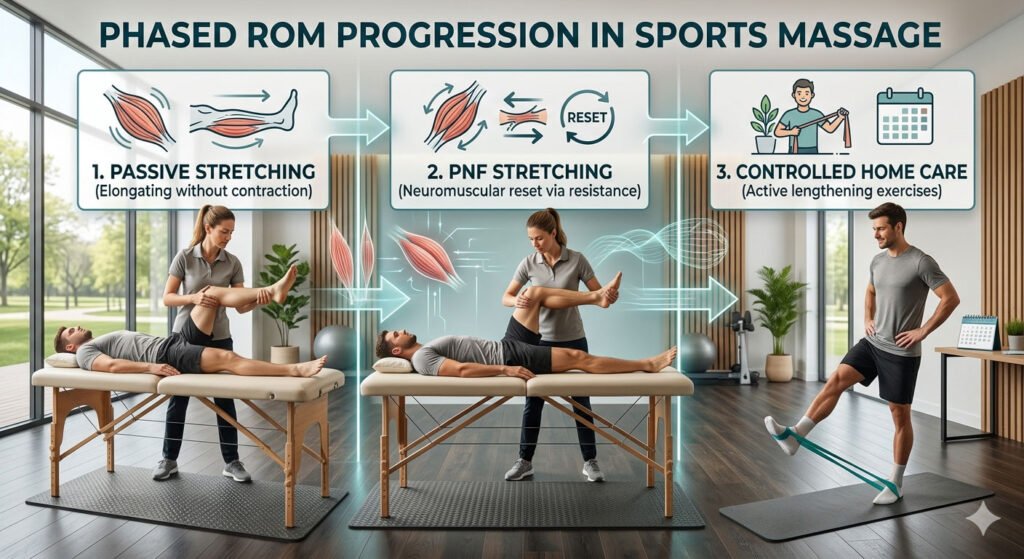
RMTs use an interactive, phased approach to safely restore optimal muscle length and joint mobility during the sub-acute phase:
Passive Structural Stretching
While the muscle is completely relaxed, the therapist gently extends the limb to its safe tissue barrier. This applies a controlled, low-load stretch to the newly formed collagen fibers, encouraging them to realign in a parallel, functional pattern rather than a tangled, chaotic clump.
Proprioceptive Neuromuscular Facilitation (PNF)
As the tissue continues to heal, RMTs introduce PNF stretching techniques, such as the Contract-Relax method. The athlete performs a mild, isometric contraction against the therapist’s resistance for several seconds, followed immediately by complete relaxation.
During this relaxed window, the therapist safely moves the limb into a deeper range of motion. This neurological reset bypasses overactive muscle spindles, resetting the muscle’s resting length and rapidly expanding pain-free joint mobility.
Clinical Comparison: The RMT Rehabilitation Matrix
For coaches, trainers, and athletes planning a recovery strategy, this breakdown outlines how specific manual therapy interventions directly address the physiological limitations of a sub-acute strain:
| Clinical Limitation | RMT Manual Intervention | Physiological Outcome |
|---|---|---|
| Fascial Restrictions | Myofascial Release & Sustained Shearing | Restores independent tissue gliding; thins thickened interstitial fluids. |
| Avascular Scar Tissue | Rhythmic Petrissage & Longitudinal Flushing | Induces localized hyperemia; delivers oxygen and amino acids for repair. |
| Lingering Exudate & Debris | Lymphatic Clearing & Broad Compressions | Reduces chemical nerve irritation; accelerates local fluid recycling. |
| Shortened/Disorganized Fibers | Passive Stretching & PNF Techniques | Aligns new collagen strands parallel to natural lines of muscle pull. |
Safeguarding Your Sports Recovery Journey
In Ontario’s multidisciplinary healthcare framework, successful sports rehabilitation rarely happens in isolation. Every professional session within the RMT Clinic Network is backed by detailed, secure digital charting (SOAP notes) that tracks your specific range-of-motion baselines and tissue healing markers.
Our therapists frequently coordinate care plans directly with allied physiotherapists and chiropractors. This collaborative approach ensures that while your RMT focuses on breaking down fascial restrictions and restoring tissue flexibility, your wider rehab team can safely prescribe progressive strengthening exercises. This comprehensive, integrated strategy is the most effective way to help you return to your sport stronger, faster, and fully protected against future re-injury.

Author: Henry Tse
Henry Tse, Founder and CEO of the RMT Clinic Network Organization—an integrated platform created to connect patients with trusted para-medical providers while helping practitioners build stronger, more profitable clinics using practical, real-world business systems. After launching, operating, and selling multiple wellness businesses, I repeatedly saw the same two challenges: patients struggled to find the right care close to them, while practitioners struggled to attract consistent bookings and build predictable, compliant, and sustainable businesses. I created the RMT Clinic ecosystem to solve both problems. Through our Canada-wide “near me” directory, specialized brand marketing solutions, and step-by-step training academy, we help patients discover qualified providers while giving Registered Massage Therapists and clinic owners the systems, tools, and strategies needed to turn their professional skills into scalable businesses. Core Values Innovation • Empowerment • Community Professional Background * Vice President and General Manager, Canadian Small Business Institute: 15 years as a senior business consultant and trainer. * Direct Marketing and Advertising, 1997–Present: Strategy, brand positioning, lead generation, and business development. * Wellness Clinic Owner and Operator, 2005–Present: Launched and operated nine clinics, with three active RMT clinics currently under management. > If you are an RMT or clinic owner looking for more bookings,...